
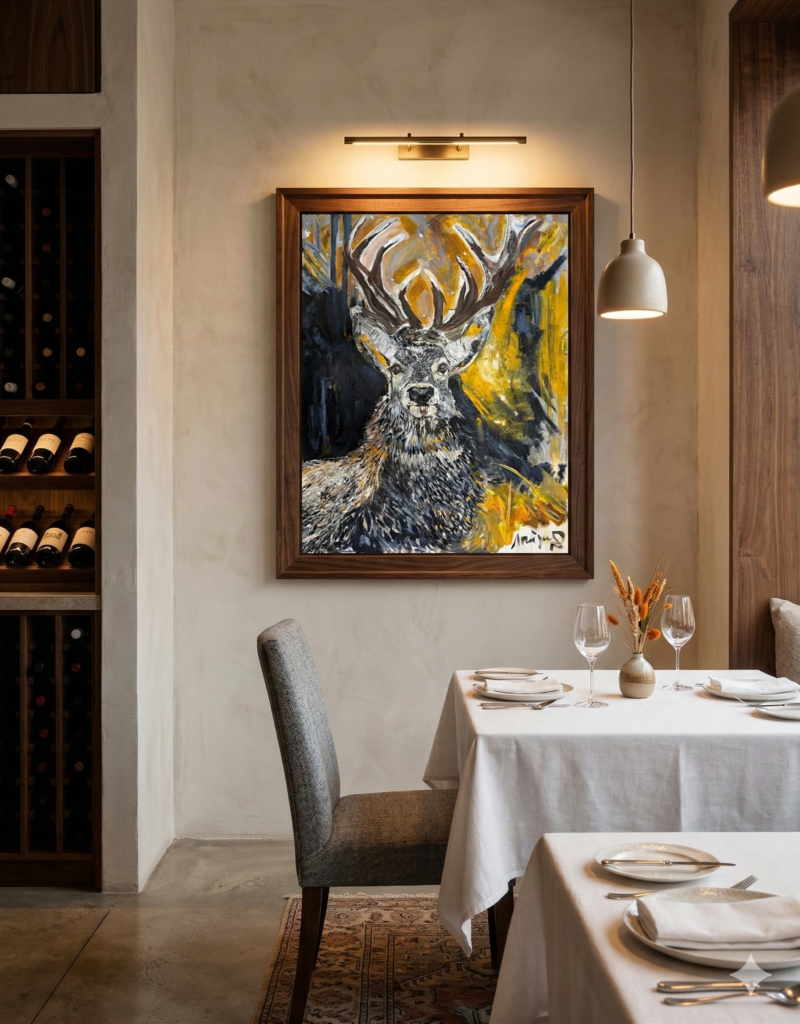
Choosing art for a corporate environment is one of the most visible decisions you can make about your brand. Done well, it communicates values before a single word is spoken, shapes how staff and visitors feel in a space, and signals the kind of organization you are. Done poorly — or defaulted to generic prints — it becomes invisible background noise.
This guide covers everything a corporate buyer or facilities manager needs to know: why original commissioned art outperforms off-the-shelf alternatives, how to match artistic style to your space and brand, and what to expect at every stage of the commission process.
Key Takeaways
- Originals outperform prints emotionally: Studies in psychology and neuroscience show that people report up to ten times more intense emotional responses when viewing original works versus reproductions.
- Match art to function: Reception areas, boardrooms, open offices, and executive spaces each benefit from different styles, scales, and energy levels.
- Commission = control: Working directly with an artist gives you input on size, palette, subject, and composition — something no gallery or print retailer can offer.
- The process is simpler than you think: From first inquiry to installed artwork typically takes six to eight weeks for a single feature piece.
Budget strategically: Invest in originals for high-visibility spaces (lobby, boardroom); high-quality prints or editions work well in corridors and secondary areas.
Why Original Art Makes a Stronger Statement Than Prints
The case for original art in a corporate context goes beyond aesthetics. It is a strategic decision with measurable impact on perception, culture, and brand identity.
Uniqueness signals intention
An original work is, by definition, one of a kind. No other office, hotel lobby, or boardroom owns that exact object. In a corporate environment where first impressions carry significant weight, that singularity communicates something that a mass-produced print simply cannot: that the people who work here made a deliberate, considered choice.
Psychologists note that humans assign special value to objects that came directly from a creator’s hand. Copies and reproductions, even when visually identical to the original, are consistently judged as less meaningful. Owning the original connects your space to an act of creation in a way that a print cannot replicate.
Emotional and sensory impact
Research in psychology and neuroscience consistently shows that people report significantly stronger emotional responses when viewing original artworks compared to reproductions — with some studies documenting responses up to ten times more intense. The physical qualities of an original — brushstroke texture, paint thickness, the subtle imperfections of a human hand — carry an energy and presence that a flat reproduction cannot convey.
In a professional setting, that heightened presence matters. Original art becomes a conversation starter. Clients pause in front of it. Staff notice it. It earns attention in a way that a framed print rarely does.
Visual authority in a space
Interior designers consistently use original artwork as the primary anchor for a corporate interior (Mash Gallery) — the piece that sets the mood, establishes the palette, and gives the room a clear focal point. A well-chosen large-format original with bold scale, colour, or texture elevates even a modest or minimalist environment around it (via Mash Gallery).
Critically, originals help a space feel curated rather than assembled from a catalog. That distinction — intentional versus generic — is immediately legible to clients, partners, and prospective talent walking through your doors.
If you are weighing originals against prints for a specific space, this prints vs. originals breakdown is a useful reference.
How to Choose the Right Artist and Style for Your Corporate Space
The most common mistake in corporate art procurement is starting with the art rather than the brief. The right approach is to define what you need the space to do first, then find the art that serves that function.
Step 1 — Clarify brand, audience, and mood
Before approaching any artist or gallery, answer three questions:
- What do you want visitors and staff to feel in this space? Calm and focused? Energized and creative? Trustworthy and established? The answer shapes every decision that follows.
- What are your company’s core values? Innovation, sustainability, community, tradition — these can be translated directly into visual language: materials, themes, colour temperature, and subject matter.
- Who sees this work most? Clients and the public require a different register than internal staff spaces. A client-facing lobby demands more polish and deliberate intent than a break room.
A sustainability-focused firm, for example, might prioritize nature-inspired landscapes in earth tones and greens — making values visible the moment someone enters the building, without a word of explanation (art as branding).
Step 2 — Match style to space and function
Different areas of a corporate environment serve different psychological functions (office art guide), and the art should reflect that.
Area | Recommended Styles | Why It Works |
|---|---|---|
Reception / Lobby | Contemporary, nature-inspired, refined figurative | Sets first impression — polished yet welcoming |
Boardroom / Meeting rooms | Calm landscapes, geometric minimalism, abstract | Reduces visual noise, supports focus and conversation |
Open work areas | Bold abstract, optimistic contemporary | Adds creative energy without distraction |
Executive offices | Statement pieces, mid-century, subtle expressionist | Communicates authority, sophistication, and clarity |
Break rooms / Lounges | Nature scenes, softer contemporary, warmer palettes | Helps people decompress and reset |
Step 3 — Decide on subject, colour, and medium
Subject: Abstract and geometric work is flexible and brand-neutral, making it easy to integrate across a range of corporate identities. Landscapes, cityscapes, or industry-adjacent imagery tell clearer stories about your organization’s relationship to place and purpose.
Colour: The most effective corporate art either echoes the brand palette directly or complements the existing interior finishes — flooring, furniture, wall colour. Art that feels integrated reads as intentional; art that clashes reads as an afterthought.
Medium: Original paintings and mixed-media work read as substantial and unique — appropriate for high-visibility spaces. Photography, prints, and digital works can work well in corridors or large-scale installations. Sculpture can anchor lobbies and double-height atriums when the budget and space allow.
Step 4 — Choose the right artist
Once you have a clear brief, look for artists whose existing body of work naturally fits it — in subject matter, palette, scale, and energy. Avoid asking an artist to work far outside their established language (choosing workplace art); the results are rarely as strong as work that comes from genuine creative conviction.
Consider the following when evaluating artists:
- Local artists can anchor a sense of community and regional identity — particularly powerful for organizations with strong ties to a specific place or landscape.
- Artists whose materials align with your values — sustainable or innovative materials can extend brand storytelling into the artwork itself.
- Scale and track record — review their largest completed works and ask whether they have experience with corporate or institutional clients.
A well-chosen commission integrates subtle references to your organization’s story — geography, history, milestones, values — turning the space into brand narrative rather than mere decoration. For a deeper look at how companies use art to boost productivity and brand image, this overview from MOMAA is worth reading.
If you are considering commissioning a piece for your own space, the commission process at Monique Paré is a good example of how a direct artist engagement works in practice — from initial brief through to delivery.
The Commission Process — What to Expect From Inquiry to Delivery
The commission process is more straightforward than most corporate buyers expect. For a single feature painting, the typical timeline from first inquiry to installed artwork is six to eight weeks. Here is what each stage involves.
Stage 1 — Initial inquiry and discovery
The process begins with a brief: space dimensions and photos, timeline, approximate budget, and a description of the desired mood or subject. A good artist will follow this with a short discovery conversation — in person, by video, or by phone — to discuss brand values, colour constraints, how the artwork should make staff and visitors feel, and whether framing and installation are required.
This discovery stage is where the real work happens. The more clearly you can articulate the brief at this point, the stronger the final result will be.
Stage 2 — Proposal, quote, and agreement
Based on the discovery, the artist prepares a proposal covering: project description, approximate sizes, medium, creative direction, timeline, and fee structure — including taxes, framing, and installation where applicable.
Once the proposal is accepted, a commission agreement is issued. It typically covers scope, schedule, review points, revision limits, copyright and usage terms, delivery and installation, and payment milestones (commission contracts guide). Corporate art commissions commonly use a 50% deposit to begin work and 50% on completion, though larger projects may use phased payment structures.
Stage 3 — Concept development and approvals
After the deposit, the artist develops concept materials: a mood board, colour palette, and one to three sketches or digital mockups showing how the artwork will look in your actual space. This is the stage at which corporate stakeholders — design leads, brand managers, executives — typically provide consolidated feedback.
Plan for one to two rounds of refinement before concept approval. Clear internal alignment at this stage prevents costly change requests later.
Stage 4 — Creation and progress updates
With the concept approved, the artist begins the work. For corporate commissions, regular progress updates — photographs or short videos at key stages — keep stakeholders informed without micromanaging the creative process. Minor adjustments to colour or contrast can often be accommodated during this phase; significant changes are treated as scope changes with associated fees and timeline impact.
Stage 5 — Final review, framing, and delivery
When the painting is complete, the artist provides high-quality images for final approval — or, where practical, arranges an in-person viewing. Once approved, the remaining balance is paid, framing (if included) is coordinated to complement both the artwork and the corporate interior, and delivery is scheduled with appropriate protective packaging and insurance for large or high-value works.
Stage 6 — Installation and aftercare
Professional installation ensures the work is hung at the correct height, aligned properly, and mounted securely for the wall construction and foot traffic of the space. Upon completion, the artist provides a certificate of authenticity, basic care instructions, and — if required for internal communications or signage — a short artwork statement.
For larger collections or high-profile installations, optional additions include an art inventory sheet, branded wall labels, and photography suitable for PR and internal culture materials.
Example timeline — single feature painting
Week | Milestone |
|---|---|
Week 1 | Inquiry, discovery call, space photos, and proposal |
Week 2 | Contract signed, deposit paid, initial concepts delivered |
Week 3 | Feedback and final concept approval |
Weeks 4–7 | Painting creation with progress updates |
Week 8 | Final approval, framing, delivery, and installation |
Summary
Original art commissioned directly from an artist gives a corporate environment something that prints and off-the-shelf alternatives cannot: a one-of-a-kind work built around your brand, your space, and the specific impression you want to make on everyone who walks through your doors.
The process — when clearly briefed and well-managed — is straightforward, predictable, and far less complicated than most buyers anticipate. The result is a space that communicates intention, elevates the environment, and earns attention for years.
For more on art in professional spaces, see the Corporate Buying Guide — a practical resource for procurement, scale, and delivery considerations.