
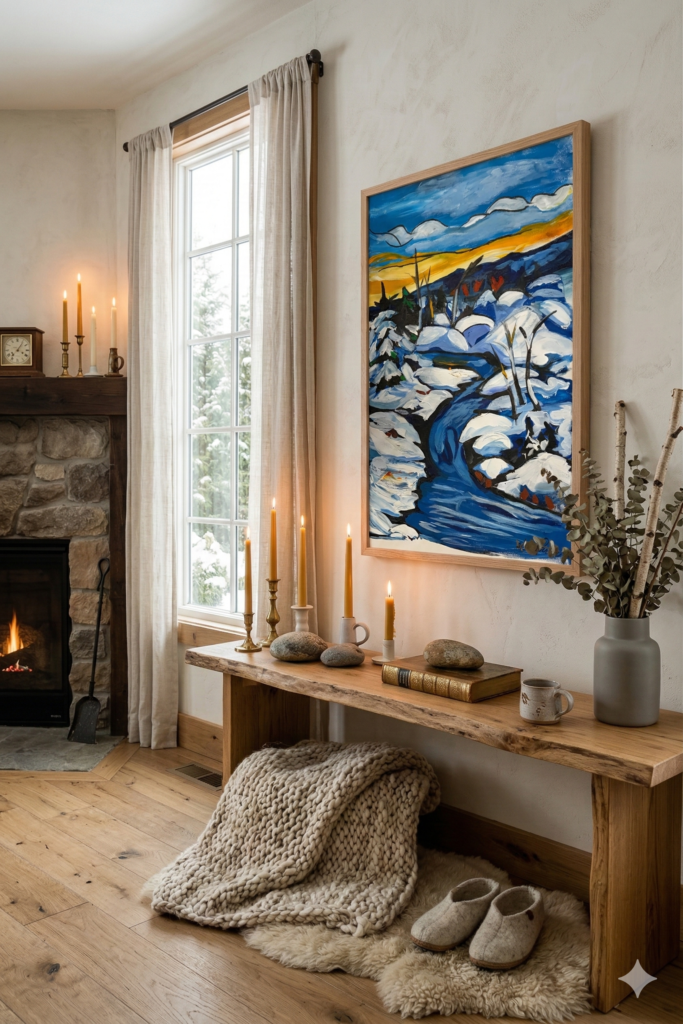
How to Incorporate Landscape Wall Art for Living Room
Landscape wall art for living room does more than fill a blank wall. It introduces depth, sets a horizon and creates a visual resting point that ties a seating area together. Scenic pieces use scale, color and subject to shape mood: calm coastlines soften a room, moody mountains add drama and abstract fields change with the light.
Panoramic works can read like a window while smaller canvases act as sculptural objects within the space. Decide whether the painting should feel like a view or an object you arrange around, then plan scale, color and placement accordingly. The following sections cover practical sizing rules, hanging tips and styling moves to make the art feel intentionally placed.
Key takeaways
- Anchor with horizon: Landscapes introduce a horizon and layered planes that become the room’s visual resting point; pick a scene that balances your seating area.
- Size to scale: Aim for artwork that spans 60–75% of your sofa and hangs 6–12 inches above the back for balanced proportion.
- Originals vs prints: Choose originals for texture and provenance; choose prints or canvases for faster, budget-conscious large scale.
- Material and finish: Prefer canvas or linen, archival paints, a complementary frame and a subtle varnish to protect color and show presence.
- Hang and light: Use proper hardware, center at eye level, add directional lighting and test scale with paper templates or a photo mockup.
Why a landscape can anchor your living room
Match the painting’s style to the room: abstract landscapes work with minimal, modern interiors, coastal scenes pair with light woods and simple textiles and panoramic vistas suit eclectic or rustic spaces. Think about whether the artwork should read like a window or act as an object against the wall. Exact sizes, aspect ratios and hanging tips follow to help a landscape read like a view rather than just an object.
Sizing and placement for landscape wall art for living room
Start with a simple rule: artwork should span about 60–75% of the sofa width to keep most rooms balanced. For a 7 to 8 foot sofa that equals roughly 50 to 72 inches, which explains why common landscape sizes such as 24×36, 30×40, 36×48, 40×60 and 48×72 scale well above seating. Use sofa width × 0.6 for minimum art width and sofa width × 0.75 for maximum; aspect ratios near 3:2 or 4:3 feel wide without becoming overly tall. For more practical examples and visual guidance, see a detailed guide to choosing the right size wall art above your sofa.
| Sofa Width | Min Art Width (×0.6) | Max Art Width (×0.75) | Recommended Canvas Sizes | Hanging Height Above Sofa |
|---|---|---|---|---|
| 6 ft (72 in) | 43 in | 54 in | 24×36, 30×40 | 6–8 in (low sofa) |
| 7 ft (84 in) | 50 in | 63 in | 36×48, 40×60 | 8–10 in (standard) |
| 8 ft (96 in) | 58 in | 72 in | 40×60, 48×72 | 10–12 in (tall/high ceiling) |
Choose a single bold canvas or a multi-panel layout by considering sightlines and ceiling height. A large single canvas creates a clear focal point, while a diptych or triptych introduces movement and can echo architectural rhythms. When combining panels, calculate the total span by adding each panel’s width plus 2 to 3 inch gaps; for example, three 24×36 panels with 2 inch gaps yield an effective 76 inch presence.
Mocking up scale removes guesswork: measure your sofa, mark the wall centerline at 57 to 60 inches for average eye level and tape kraft-paper templates to test proportion. Aim for 6 to 12 inches between the top of the sofa and the bottom edge of the art, with 8 to 10 inches often feeling ideal; reduce to 6 to 8 inches for low sofas and increase slightly for taller seating or high ceilings. Use painter’s tape for templates, a laser level to align centerlines and a stud finder for secure hanging, then view from the main seat to confirm balance.
Materials, framing and finishes that make landscapes sing
Canvas and linen remain the go-to supports when you want painterly, tactile presence in living room art. Cotton duck canvas is economical and smooth, which suits large sizes and tighter budgets, while linen canvas fabric offers more texture, better dimensional stability and stronger presence for impasto and palette-knife work. Choose gallery-wrap for a modern, unframed look or linen when texture should anchor a neutral interior.
Metal, wood and acrylic answer different aesthetic and practical needs. Metal panels deliver saturated, luminous color and resist moisture, making them suitable for sunlit or humid spots. Wood panels bring warm grain and a furniture-like quality that pairs with natural-fiber interiors, while acrylic adds depth and gloss but requires careful handling and cleaning. For a straightforward comparison of metal and canvas options, consult a canvas vs metal prints comparison to weigh sheen, durability and cost.
Frame and finish change how a piece reads and influence perceived scale. Float frames give breathing room around a canvas, slim black frames read contemporary and wide wood frames add weight and traditional scale. For originals apply a spray or brush-on varnish to protect the surface and unify sheen; for prints consider glazing with museum glass or anti-reflective acrylic to reduce glare in bright rooms.
Quick checklist: for tactile depth choose linen with a float frame, for vibrancy and durability select metal or acrylic and for warmth pick wood with a wide frame. These choices help the artwork function as both art and an integral part of the room, whether you select an original or a landscape print. The next section explains how color and palette determine mood and scale.
Color, style and coordination for landscape wall art for living room
Make color choices intentional by echoing one color from the painting in small soft furnishings, keeping the room’s dominant palette neutral and adding contrast when you want drama. Pick a single hue from the painting—a green leaf, a terracotta note or a slate blue—and repeat it in a cushion, throw or vase to create cohesion without matching everything. Small echoes make the artwork feel connected to the rest of the room.
- Earthy: terracotta, olive and warm cream; try an olive cushion and a terracotta ceramic vase.
- Coastal: pale blue, linen and bleached wood; add a linen throw and a light wood tray.
- Dramatic: deep indigo, warm neutrals and brass; place an indigo cushion and a brass lamp for contrast.
Match artwork style to furnishings: abstract pieces pair with minimalist furniture and sculptural lighting, while coastal scenes favor light woods, linen sofas and woven seagrass baskets. For large landscape paintings choose low-profile seating so the art becomes the room’s horizon. Remember that texture, scale and light change how color reads: impasto and canvas weave boost perceived saturation while matte textiles soften it.
Balance a saturated painting with matte rugs or soft upholstery and reserve glossy surfaces for small accents so nothing competes. Use warm bulbs between 2700 and 3000K and position lights at about 30 degrees to flatter color while avoiding glare. Dimmers and layered ambient lighting help the painting read well at different times of day.
Hanging, hardware and lighting for a pro finish
Match hardware to wall type and artwork weight to keep installations secure. Small prints hang on picture hooks, medium canvases do well with screws into studs and very heavy canvases are safest using a french cleat or multiple studs. Use toggle bolts for hollow drywall when studs are unavailable and consider a professional installer for pieces over 50 pounds. For more on selecting the correct fittings, this guide on how to choose picture frame hanging hardware is a useful reference.
Lighting transforms a good install into a gallery finish. Picture lights suit small works, adjustable track fixtures suit grouped compositions and recessed or wall-wash fixtures flatter wide landscape pieces and reveal brushwork and depth. Angle lights to about 30 degrees to minimize glare and choose warm LED bulbs to enrich oil and acrylic colors without accelerating fading.
Before you hang, walk the space with a tape measure, a paper mockup and your selected hardware to avoid surprises. Keep a simple checklist that includes the correct hanging height, appropriate anchors and proper beam angles, plus a safety plan for heavy pieces. Confirm placement from the main seating spot before committing to holes in the wall.
Where to buy, budgets and why curated originals matter
Where you buy depends on how much customization you want and your budget. Mass-market prints and canvases can start in the low tens to low hundreds, mid-tier retailers with AR previews and framing options typically range from about $150 to $800 for larger pieces, and gallery or artist originals often start around $1,000 and rise with size and medium. Check retailer tools like AR room previews, clear return windows and condition photos to reduce uncertainty before purchasing. If you are buying for a business or larger install, consult the Corporate Buying Guide for Landscape Art, Monique Paré for procurement and delivery best practices.
A commissioned original gives scale, a tailored palette and an emotional match that off-the-shelf options cannot provide. Vibrant Mountain Painting Ideas for Your Living Room, Monique Paré showcases examples of commissioned landscapes and explains how a tailored piece can be made to suit your space. Commissioned work prevents repetitive prints and ensures composition and gesture suit your space when you want art that feels personal and lasting.
Compare shipping, insurance and white-glove delivery for large works and inspect framed pieces on arrival. Photograph the packaging before opening, confirm stretcher bars and frame corners and keep original packing to report damage within the seller’s stated window. These arrival checks protect your purchase and simplify any claims process.
- Photograph the packaging before opening it.
- Confirm stretcher bars, frame corners and varnish condition.
- Keep original packing and report damage within the seller’s stated window.
Landscape wall art for living room should feel inevitable: the right size, material and color will make the rest of the room fall into place. As a practical path, pick a scale that spans 60–75% of your sofa, choose a material that fits your lifestyle, echo one or two room accents and secure the work with proper hardware and lighting. Curated originals and commissions are the most direct way to get a perfectly scaled, emotionally precise piece that anchors your space for years.
For more tips, examples and behind-the-scenes process notes, see Blog, Monique Paré for additional inspiration and how-to posts.
Anchor your living room with landscape wall art
A well-chosen landscape becomes the room’s visual anchor by introducing a clear horizon and layered depth that invite the eye to rest. Use archival paints, a complementary frame and a subtle varnish to protect the work and enhance color so the piece reads like a window into the space.